Here's the story:
Cerid's brother, Kegan, is a second year cadet at the U.S. Merchant Marine Academy in King's Point, NY. As part of his studies, he went to sea for a trimester on a large commercial container ship, called the Philadelphia Express. Having travelled from Houston to Miami, Miami to Charleston, Charleston to Norfolk, then across the Atlantic to Antwerp and Bremenhaver. Finally, Kegan ended up docking for a few hours in Isle of Grain, England at the mouth of the Thames River, which runs through the heart of London. So, Cerid being an adventurous soul, decided that we should rent a car and drive the 47 miles to Isle of Grain to pick up Kegan and hang out for a few hours in the surrounding towns. At 4 or so in the afternoon, we arrived at Enterprise, which only had manual cars, meaning I had to drive. After great doubts and a personal, internal struggle about the potential safety of ourselves and the entire London community (pedestrians, other driver, and cyclists), we decided to try. Sitting on the right side, shifting with my left hand, and driving on the left side was a bit of a change, but I had a great navigator and we made it out of London and to Isle of Grain in one piece. Below are a collection of pictures from our half day journey.
If you are interested in the history of the Rochester castle and the Rochester Cathedral (both very very old--circa 11th century), you can click for the Rochester Castle or the Rochester Cathedral (a church which has origins directly tied to St. Augustine of Hippo).


Thursday, January 8, 2009
Our trip to Isle of Grain and Rochester to see Kegan

Monday, January 5, 2009


Wednesday, December 31, 2008


Sunday, November 30, 2008
Go buy this ASAP
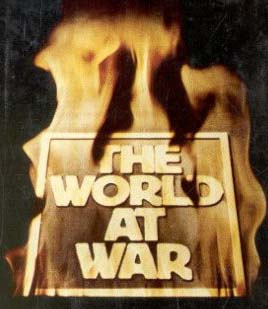
The World at War is a 26-episode television documentary series on World War II, including the events leading up to it and following in its wake. The series was produced by Jeremy Isaacs for Thames Television (UK). Commissioned in 1969, it took four years to produce, such was the depth of its research. It premiered on ITV in 1973 at a cost of £900,000, a record (at the time) for a British television programme. The series was narrated by Laurence Olivier and its score was composed by Carl Davis. A book, The World at War, was written to accompany the series by Mark Arnold-Forster.
The series interviewed leading members of the Allied and Axis campaigns, including eyewitness accounts by civilians, enlisted men, officers and politicians, amongst them Albert Speer, Karl Dönitz, Jimmy Stewart, Bill Mauldin, Curtis LeMay, Lord Mountbatten, Alger Hiss, Toshikazu Kase, J.B. Priestley, Brian Horrocks, Lawrence Durrell, Arthur Harris, Charles Sweeney, Paul Tibbets, Anthony Eden, Traudl Junge and historian Stephen Ambrose.
Jeremy Isaacs says in "The Making of The World at War" (included on the DVD set) that he sought to interview, not necessarily the surviving big names, but their aides and assistants. The most difficult subject to locate and persuade to be interviewed, according to Isaacs, was Heinrich Himmler's adjutant, Karl Wolff. The latter admitted to witnessing a large-scale execution in Himmler's presence.
It is often considered to be the definitive television history of the Second World War. Some consider it the finest example of the documentary form. It also presented rare colour film footage of some of the war's events.
In a list of the 100 Greatest British Television Programmes drawn up by the British Film Institute in 2000, voted for by industry professionals, The World at War ranked 19th.
Sunday, November 23, 2008
Still true today I think
In C.S. Lewis' "Surprised by Joy," his autobiography, he notes that:
"The truest and most horrible claim made for modern transport is that it 'annihilates space.' It does. It annihilates one of the most glorious gifts we have been given. It is a vile inflation which lowers the value of distance, so that a modern boy travels a hundred miles with less sense of liberation and pilgrimage and adventure than his grandfather got from traveling ten. Of course if a man hates space and wants it to be annihilated, that is another matter. Why not creep into his coffin at once? There is little enough space there."
Tuesday, November 4, 2008
A few great words of wisdom from a wise man quoting another wise man
Borruso was only repeating what, at one time, all the great thinkers knew when he said, "truth is always the agreement of the mind with what is," but he also said, "truth has never claimed to offer happiness. Very often it offers discomfort at best, persecution and even death at worst. The one thing it offers--and delivers--is interior freedom."


